
A family with two children will collect roughly £2,342 per year in UK Child Benefit starting April 2026. That figure went up 3.8% this tax year, and the claim itself takes one form and a birth certificate.
But the part that trips people up has nothing to do with paperwork. It is a tax charge that kicks in at £60,000 of individual income, and it has convinced thousands of eligible parents to stop claiming altogether.


This article is for first-time parents, guardians, or anyone who opted out of Child Benefit because someone said it "wasn't worth the hassle" above £60,000. That advice is about to age very badly.
The 2026/2027 Child Benefit Rates
The numbers for the current tax year, effective April 2026, are straightforward. £27.05 per week for the eldest or only child. £17.90 per week for each child after that.
Paid every four weeks, that works out to £108.20 for the first child per cycle and £71.60 for each additional child. Guardian's Allowance also increased, rising to £22.95 per week.
How Those Rates Compare to Last Year
The 2025/2026 rates were £26.05 for the eldest child and £17.25 for each additional child. The 3.8% bump followed the September 2025 Consumer Price Index reading.
| 2025/2026 | 2026/2027 | |
|---|---|---|
| Eldest child (weekly) | £26.05 | £27.05 |
| Additional child (weekly) | £17.25 | £17.90 |
| Two-child family (annual) | ~£2,252 | ~£2,342 |
That's an extra £90 per year for a two-child household. Small on its own. Compounded over 16 years of a child's eligibility, the total lifetime payment sits above £37,000 for two kids.
The CH2 Form: Applying for Child Benefit Step by Step
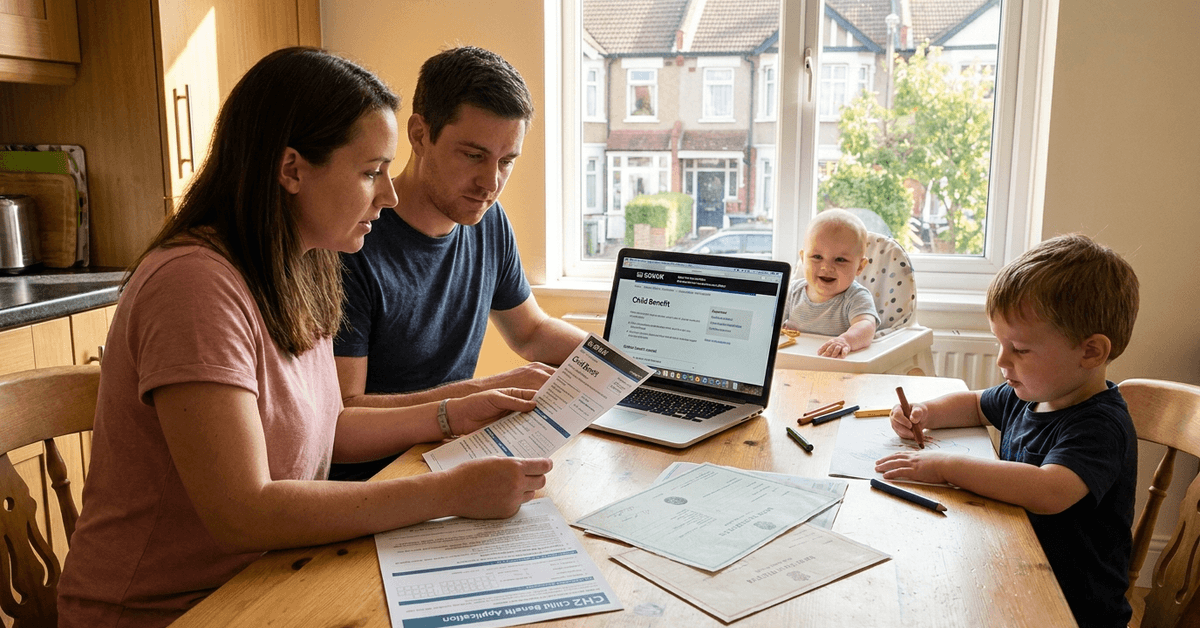
Claiming requires one form called the CH2. It is available as a paper download from GOV.UK's Child Benefit page. Hospitals sometimes hand it out after a birth, but the online version is always current.
Documents to Prepare
A complete application needs a short list:
- The child's original birth or adoption certificate (copies are not accepted)
- The claimant's bank or building society details for payment
- Proof of guardianship if the claimant is not named on the birth certificate
- Immigration status documents for non-UK nationals claiming under lawful residence
Missing documents are the single biggest cause of processing delays. HMRC will return originals, but the turnaround can take weeks.
Filling Out and Sending the CH2
Each section covers one child. Parents claiming for multiple children fill additional sections on the same form. Children born outside the UK require extra fields, so read the form notes before starting.
The completed CH2 goes by post to the Child Benefit Office. The address is printed on the form. Some newborn claims can now be started online, but most applications still run on paper.
What Happens After Submission
Expect a processing window of four to eight weeks. HMRC may request additional documents or proof of relationship during that time.
Once approved, an award letter arrives confirming the payment amount and schedule. Payments are backdated to the Monday after HMRC received the claim, so filing promptly matters.
The High Income Child Benefit Charge and Why Opting Out Is a Mistake
This is where the £60,000 question sits. The High Income Child Benefit Charge currently applies when the higher-earning parent's adjusted net income crosses £60,000.
The charge claws back 1% of the total Child Benefit for every £200 earned above that threshold. At £80,000, the full benefit is reclaimed.
I would argue that opting out of Child Benefit payments above £60,000 is one of the worst pieces of financial advice circulating in UK parenting forums, and the HMRC data supports it. Around 485,000 families are affected by the HICBC, many of them single-earner households.
The National Insurance Credit Nobody Prices In
Claiming Child Benefit, even if every penny gets clawed back by the HICBC, earns the non-working parent National Insurance credits toward their State Pension.
A parent who stays home for 10 years without these credits could lose over £25,000 in lifetime pension income. The annual hassle of a Self Assessment return looks different against that number.
And as of January 2026, even Self Assessment is no longer required for many. HMRC introduced a PAYE service allowing employees to pay the HICBC directly through their tax code, removing the mandatory Self Assessment filing for those with no other reason to file.
The April 2026 Household Income Switch
The biggest structural change in years lands this tax year. The HICBC is shifting from an individual-earner basis to a household income basis starting April 2026. Under the old rules, a household where one parent earned £80,000 and the other earned nothing lost all Child Benefit.
A household where both parents earned £59,000 each, totaling £118,000, kept the full amount. The new system will assess combined adjusted net income of both partners.
Specific household thresholds are still being finalized, but the direction is clear: dual-income families previously untouched may now face partial charges, while single-earner families get relief.
Keeping the Claim Active After Approval
Life changes require updates to the Child Benefit Office. Miss one, and overpayment penalties follow.
Reportable changes include:
- A child leaving approved education or training before age 20
- A child moving abroad or changing primary residence
- Custody changes between parents or guardians
- A partner moving in or out of the household (now especially relevant under the household-based HICBC)
HMRC's Child Benefit tax calculator can estimate the charge at different income levels, which helps planning around salary sacrifice or pension contributions.
Two-Child Cap Removal and What It Means for Larger Families
The two-child cap on the Universal Credit Child Element is being scrapped from April 2026. This does not change Child Benefit itself, which has never had a cap on the number of eligible children.
But it does change the total picture for families with three or more children claiming Universal Credit alongside Child Benefit.
A family with four children previously received the UC Child Element for only the first two. That restriction is lifting. Combined with Child Benefit at £27.05 plus three additional children at £17.90 each, the annual household support package grows substantially.
Common Mistakes That Delay or Reduce Payments
Three errors show up repeatedly in Child Benefit claims:
- Sending photocopies instead of original birth certificates. HMRC rejects copies, and the resubmission adds weeks.
- Not claiming because of the HICBC. Opting out of payment is fine. Not claiming at all forfeits National Insurance credits with no way to backdate them beyond three months.
- Forgetting to update after a child turns 16. Child Benefit continues until age 20 if the child stays in approved education or training, but only if the parent confirms this with HMRC. Payments stop automatically at 16 without that confirmation.
Questions People Ask About UK Child Benefit
These come up in nearly every search thread on the topic.
- Q: Can both parents claim Child Benefit for the same child?
Only one person per child can receive Child Benefit at any time. If parents separate, the parent the child lives with most should be the claimant. Disputes go to HMRC for resolution. - Q: Does Child Benefit affect Universal Credit payments?
Child Benefit counts as income for Universal Credit calculations, which can reduce UC slightly. But the reduction is smaller than the benefit amount, so claiming still results in a net gain for most families. - Q: How far back can a Child Benefit claim be backdated?
Claims can only be backdated up to three months. Filing late beyond that window means lost payments with no recovery option, which is why claiming within weeks of a birth matters.
Conclusion
The 2026 Child Benefit changes reward parents who claim, even those above the £60,000 income line. National Insurance credits alone can be worth tens of thousands in pension income over a lifetime.
Opting out to avoid a tax form no longer makes sense now that the PAYE workaround exists. File the CH2, protect the pension credits, and let the household-based HICBC sort itself out in April.