The Sembrando Vida payment jumped from 5,000 pesos to 6,450 pesos per month in 2026. That 29% increase sounds generous on paper.
But qualifying for the program means you already own at least 2.5 hectares of land. And the people who need cash transfers most in rural Mexico often own zero.



This article is for the small Mexican landowner in a rural municipality who keeps hearing about Sembrando Vida and wants to know what the program demands before the first peso hits a Banco del Bienestar card.
How Sembrando Vida Payments Work in 2026
The 2026 rules of operation, published in the Diario Oficial de la Federación on February 26, set the monthly support at 6,450 pesos per beneficiary. That money is deposited a mes vencido, meaning you get paid after the month of work, not before.
Deposits go through the Banco del Bienestar, via electronic transfers or payment orders. There is no middleman. The cash lands directly in your account.
Payment Dates and Schedule
The Secretaría de Bienestar publishes a monthly calendar. September 2026's payment, for example, was scheduled for September 9. Dates shift slightly each month, so checking the official calendar matters.
One common misunderstanding: Sembrando Vida pays monthly, not every two months like the Pensión Bienestar for older adults. Mixing those schedules up leads to unnecessary panic when the deposit doesn't show on the expected day.
The 80% Work Compliance Rule
Keeping the 6,450-peso payment requires completing at least 80% of your agreed monthly work plan. Miss that threshold, and the program can cut your support permanently.
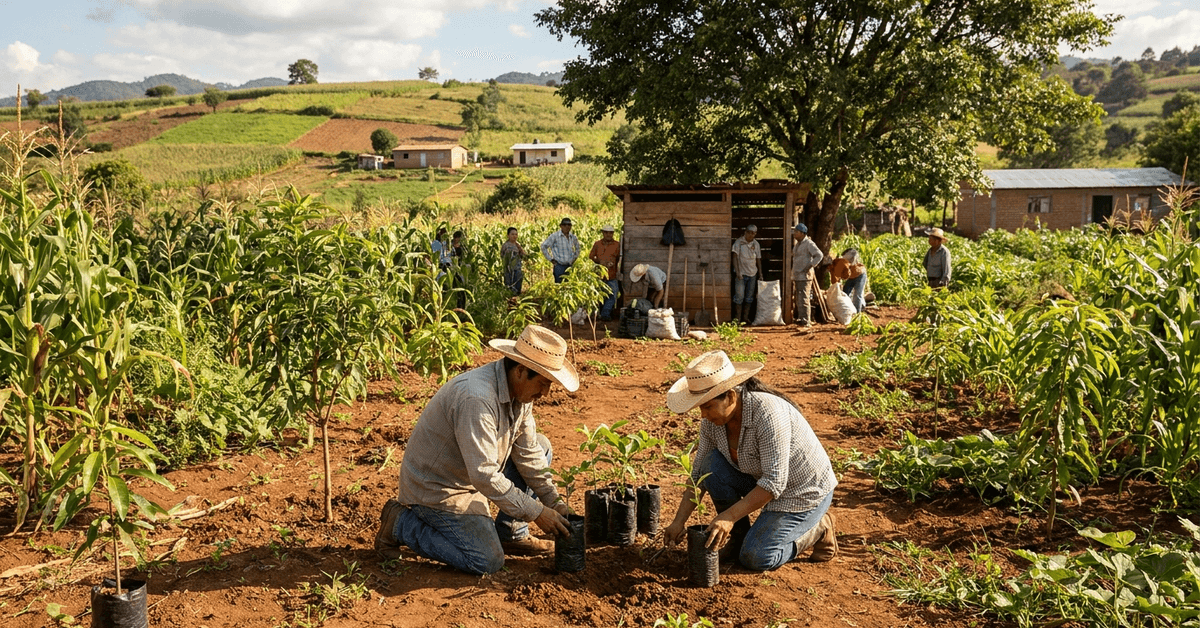
Participants must also allow technical supervision visits, attend their Comunidad de Aprendizaje Campesino (CAC) meetings, and avoid environmental damage on their plots.
I would argue that the CAC attendance requirement alone filters out anyone who can't physically show up regularly, which quietly penalizes older farmers or those with health limitations in remote areas.
Who Can Apply for Sembrando Vida
The eligibility list looks short. Passing through it is slower than it reads. Applicants must be over 18, live in a rural municipality with social lag, and have at least 2.5 hectares available for agroforestry work.
Land rights need documentation: a certificado parcelario, ejidal rights certificate, public deed, or agrarian tribunal ruling.
If the applicant doesn't own the land directly, a sharecropping or usufruct contract can work as a substitute. That flexibility matters in ejido areas where formal titles get complicated.
What Happens After Applying
Program staff have 20 calendar days to complete field visits after a request is submitted. If they don't show up, the application gets discarded.
Applicants receive a decision within 30 business days. No response in that window counts as a rejection by default. So silence is a no. Here is the gap that few articles address: the program operates through community assemblies at the ejido level.
If Sembrando Vida hasn't reached a particular municipality, there is no individual application path. A farmer in an eligible state but an uncovered municipality simply waits.
The Land Requirement Problem
I think the 2.5-hectare minimum is the single biggest design flaw in Sembrando Vida's targeting.
A February 2026 review by the Centro de Estudios para el Cambio en el Campo Mexicano (CECCAM) raised a related concern: the program delivers support only to individuals, never to communities or organizations.
That combination, individual-only plus a land floor, locks out landless laborers and families farming smaller inherited plots. The people living in deepest rural poverty rarely hold 2.5 hectares with clean paperwork.
I'd push back hard on the idea that Sembrando Vida is an anti-poverty program. At 6,450 pesos per month, it functions more like an agroforestry employment contract for people who already have land.
Where Sembrando Vida Operates in 2026
Coverage extends to 26 states with a target of up to 445,000 beneficiaries nationwide. As of early 2026, the active beneficiary count sits above 400,000, spread across roughly 1,060 municipalities and nearly 9,000 ejidos.
Gender Breakdown
The beneficiary split runs 67% men and 33% women. That two-to-one ratio reflects land ownership patterns in rural Mexico more than program bias, but the gap is worth watching as the government reportedly plans to open new registration rounds.
States with Strongest Presence
States like Chiapas, Veracruz, Oaxaca, Puebla, Guerrero, Tabasco, Yucatán, Estado de México, and Michoacán have the heaviest program activity. Coverage tends to cluster in the south and southeast, where deforestation rates and rural poverty overlap.
A quick reference on what the program delivers beyond cash:
- 6,450 pesos monthly deposited to Banco del Bienestar card
- Seeds, plants, and tools provided in-kind at no cost
- Technical training through CAC group meetings on soil conservation and crop rotation
- Field technician visits for ongoing guidance on agroforestry plot maintenance
The Deforestation Paradox
Sembrando Vida launched in 2019 as a reforestation initiative. The criticism it keeps drawing is the opposite: that it may incentivize clearing land.
UNAM researcher Omar Felipe Giraldo explained that the program's 2.5-hectare requirement applies to deforested land, which can create a perverse incentive to clear existing forest cover to qualify.
Reports from Quintana Roo described clearing of precious hardwoods like:
- caoba,
- cedar, and
- chicozapote
To build the communal nurseries (biofábricas) that program rules require.
The CECCAM review in February 2026 noted that verifying the government's claim of 1.1 billion trees planted across one million hectares is impossible because beneficiary plot locations aren't public.
The math raises questions too: that average of 1,100 trees per hectare seems high for plots that also need space for milpa crops and fruit trees under the agroforestry model.
None of this means the program delivers zero environmental benefit. It means the reforestation narrative deserves scrutiny, and applicants should understand that program supervisors care about plot compliance, not just tree counts.
Mistakes to Avoid During the Application Process
The registration process has specific friction points that trip people up. A few worth tracking:
- Missing land documentation is the top delay. Get the certificado parcelario or equivalent sorted before approaching the assembly, not after.
- Confusing payment schedules with the Pensión Bienestar leads to false alarm. Sembrando Vida pays monthly; pensions pay bimonthly.
- Skipping CAC meetings puts the entire 6,450 pesos at risk. Attendance is mandatory, not optional.
- Assuming all rural municipalities are covered. The program operates in 26 states, but only in specific municipalities. No coverage, no application path.
The official Sembrando Vida page on gob.mx publishes updated rules of operation, payment calendars, and state-level contact information. Local Centros Integradores del Bienestar handle in-person questions and troubleshooting.
| Feature | Sembrando Vida 2026 |
|---|---|
| Monthly payment | 6,450 pesos |
| Payment method | Banco del Bienestar card |
| Land requirement | Minimum 2.5 hectares |
| Compliance threshold | 80% of monthly work plan |
| Coverage | 26 states, ~445,000 target beneficiaries |
| Payment frequency | Monthly (a mes vencido) |
That 80% threshold is the number to memorize. Fall below it, and the program doesn't negotiate.
Questions People Ask About Sembrando Vida
A few searches keep coming up around this program, and the answers deserve more than a one-liner.
- Q: Can I apply for Sembrando Vida if I rent land instead of owning it?
A sharecropping contract or usufruct agreement can substitute for a property title, according to the 2026 rules. The documentation needs to be formal and verifiable, though. Verbal agreements won't pass a field visit. - Q: Do women get priority in Sembrando Vida enrollment?
The program doesn't list a formal gender quota in its 2026 rules. The 67-33 male-female split in the current beneficiary pool tracks closely with land ownership demographics. The CECCAM analysis notes that individual-only enrollment limits how collective or family-managed parcels can participate. - Q: Can I grow whatever crops I want on my Sembrando Vida plot?
No. The program prescribes agroforestry models that combine timber or fruit trees with food crops like milpa. Planting only commercial monocultures won't meet compliance requirements, and field technicians verify this during supervision visits.
Conclusion
Sembrando Vida puts real money into rural hands, but the strings attached run deeper than the deposit amount. The land floor, the work compliance rules, and the CAC attendance mandate shape who thrives inside this program.
A 6,450-peso monthly transfer rewards consistency and paperwork as much as farming skill. Anyone considering an application should start with the documentation, not the daydream.